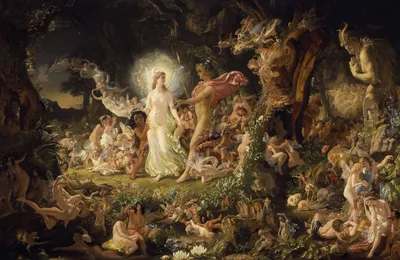
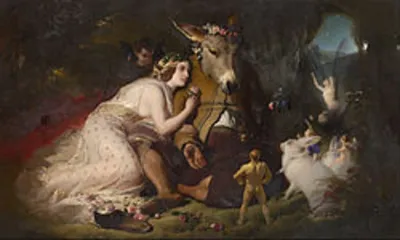
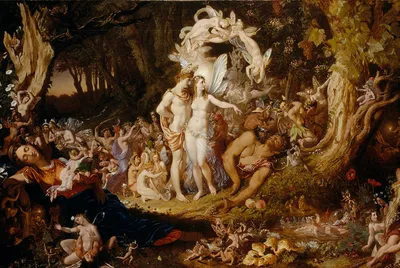
I've been interested in folklore for some time now, from the Kitsune, Yuki-onna, and Kappa as well as others such as the Dryads, Satyr, and Lamia. Fae have topped the list for some time. The elusive beings known as "Fae," which seems to be an umbrella term rather than one that points at a specified subset of creature, are a sort of magical beings tied to nature. There are tons of things floating around about Fae such as "They can't lie," "They steal names" or even children, "They hate iron," and even that they are morally neutral or tricksters. Two separate fae can be diametrically opposed in portrayal as they are subject to the narrative of the teller.
The Fae also have numerous other names by which they are called. Fae, Fey, Good Folk, Fair Folk, Kind Ones, Little People, Good Neighbors, Those who are Good and Fair, Will of Life, The People, Children of Oberon, Children of Titania, Children of Mab, and The Third Race. Interestingly enough Fae who are called children of (Oberon, Titania, and of Mab) are so through Lordship rather than direct descent as Oberon (The High King of Fae), and Titania (Queen of the Fairies) are Sovereign Rulers. The connection to Queen Mab however is a bit more symbolic. Queen Mab seems to be more a representation of the ideas that make up the various interpretations of Fae. Mab is a dream bringer.
It seems a lot of the influence around the thinking of Fae comes from Shakespeare's plays. With A Midsummer Night's Dream popularizing Oberon and Titania, as well as Queen Mab being immortalized by the famous Mercutio Speech. Perhaps more interesting than this is that in Daemonologie, King James I asserted fairies were spirits (demonic entities) that prophesied to, consorted with, and transported the individuals they served.
Recommended
-
To Read (Sources)
- Meeting the Other Crowd, by Eddie Lenihan and Carolyn Eve Green, 2003
- Spirits, Fairies, Leprechauns, and Goblins, by Carol Rose, 1996
- European Mythology, by Jacqueline Simpson, 1987
- A Dictionary of Fairies, by Katharine Briggs, 1976
- An Encyclopedia of Fairies, by Katharine Briggs, 1976
- The Fairy-Faith in Celtic Countries, by W. Y. Evans-Wentz, 1911
- The Gaelic Otherworld, by John Gregorson Campbell, 1900
- The Science of Fairy Tales, by Edwin Sidney Hartland, 1891
- British Goblins, by Wirt Sikes, 1880
- Popular Romances of the West of England, by Robert Hunt, 1865
- Legends and Traditions of the North of Scotland, by John Francis Campbell, 1860
- The Fairy Mythology, by Thomas Keightley, 1828
- Fairy Legends and Traditions of the South of Ireland, by Thomas Crofton Croker, 1825
- The Secret Commonwealth of Elves, Fauns and Fairies, by Robert Kirk, 1691
- Daemonologie, by King James I, 1603
To Read (Fiction)
- Jonathan Strange & Mr Norrell, by Susanna Clarke, 2004
- The Lord of the Rings, by J.R.R. Tolkien, 1954-1955
- The Hobbit, by J.R.R. Tolkien, 1937
- The King of Elfland's Daughter, by Lord Dunsany, 1924
- Lilith, by George MacDonald, 1895
- Phantastes, by George MacDonald, 1858
- La Belle Dame sans Merci, by John Keats, 1819
- Comus, by John Milton, 1634
- The Tempest, by William Shakespeare, 1611
- The Faerie Queene, by Edmund Spenser, 1590-1596
- A Midsummer Night's Dream, by William Shakespeare, c. 1595
- Tam Lin, c. 16th century
- Sir Orfeo, c. 14th century
Notes
- placeholder
See Also
- Faerie (soon)
- Titania (soon)
- Oberon (soon)
- Queen Mab (soon)