On the Mathematical Life
It is to the suprise of no one that has put serious effort into the meticulous study of mathematics that the subject requires the balancing of a great deal of temperance, and creative thought. I have found that even obsession to a reasonable degree is not enough. One must become immersed in the subject, wholly engaging both mind and faculties in tandem. Therefore, and for that cause I recommend my essay Toward a Mathematical Life. A guide into coaxing the unconcious mind into a state of mathematical thought through enviornmental factors, and intention.
Aspects of Modularity in Structure
As mentioned above in "Who is this for?". This roadmap was designed for the Undergrad Mathematics Major. So there is to a extend a assumption of natural talent, giftedness, perseverance, and/or passion. I suggest that most work through this list linearly as those that are naturally quick to mathematical understanding will move through this fairly quickly. I do understand that this is not possible for everyone as you may be in the middle of a semester struggling to keep up with your current work. In that case, the structure of this Syllabis was designed in such a modular way that allows for the simultaneous learning of several areas. If your goal is to fill in most of the gaps that a poor elementary, middle, and highschool education left you with. Then this is the recommended way.
Mathematical History
Mathematical Writing
Foundations of Basic Mathematics


Discrete Mathematics, Proof Writing, Naive Set Theory, Formal Logic


Combinatorics, Graph Theory, and Number Theory


Calculus, Linear Algebra, Abstract Algebra


Differential Equations and Dynamical Systems


Real Analysis, and Metric Spaces


Classic Literature Collection

On the Beauty of Mathematical Notation
Mathematics is not merely a language—it is a symphony of symbols, a choreography of logic and form. To test the robustness of our Math component, we present a flurry of expressions both elementary and esoteric.
Consider the Pythagorean Theorem in its most basic form:
Triple Integrals and Volume
A fundamental result in multivariable calculus is the computation of volume via triple integrals. For a region in 3D space, the volume is given by:
In spherical coordinates, where , , and , the Jacobian determinant introduces an extra factor of . Thus:
Summation and Limits
The Basel problem, solved by Euler, explores the value of the infinite sum of reciprocals of squares:
Nested summations can test vertical alignment and large limits:
Or even:
Stirling's Approximation and Limits
The behavior of factorials at infinity:
Fourier Transform
A classic in signal analysis:
And the inverse:
Dirac Delta Function
In distribution theory:
Gaussian Integral
A gem of analysis:
Tensor Notation and Einstein Summation
Stress test with indices:
Or an expression involving the Levi-Civita symbol:
Conclusion
This post serves both as an ode to the expressive power of mathematics and a rigorous stress test for symbol rendering.
Following our Series B last December, I'm happy to announce we've raised a $102M Series C from existing and new investors.
Our vision of the Web is a global realtime medium for both creators and consumers, where all friction and latency are eliminated.
We'll use this investment to:
1. Build the SDK for the Web [#next-momentum]
Unlike other software development platforms, the Web never came with an SDK or Standard Development Kit.
While new browser APIs are constantly being added, the responsibility still falls on the developer to assemble them into an engine for every new project.
The resulting diversity of tools and choices makes the Web the innovative and dynamic medium that it is, but it can also be a major obstacle, as companies rally to reinvent themselves in the digital medium.
React, now 8 years old, has proven to be a durable abstraction and building block, a narrative violation of the common wisdom that "frontend frameworks are changed every week."
Next.js builds on this formidable foundation to give developers and companies a meaningful starting point to build great pages, open sourcing the lessons learned from the giants of the Web.
2. Lower the barrier of entry [#realtime]
Vercel has given developers access to global infrastructure to deploy and scale frontend projects. But significant challenges remain to frictionless collaboration:
- Setting up and maintaining your developer environment
- Integrating it into Git for continuous integration
- Manually pushing and waiting to share progress with your team
Perhaps the most incredible aspect of the Web is that it's not a read-only medium. Each Web browser is simultaneously the consumption and creation mechanism.
With Next.js Live, we want to build a Web that everyone can contribute to. Whether it's to pitch in an idea or an edit, by an experienced developer or a new designer, from a local editor or the browser itself.
3. Focus on the end-user [#real]
A particularly interesting challenge of building a platform and tooling company is that you have two users (whether it's acknowledged or not):
- The user of the tool
- The user of the output of the tool
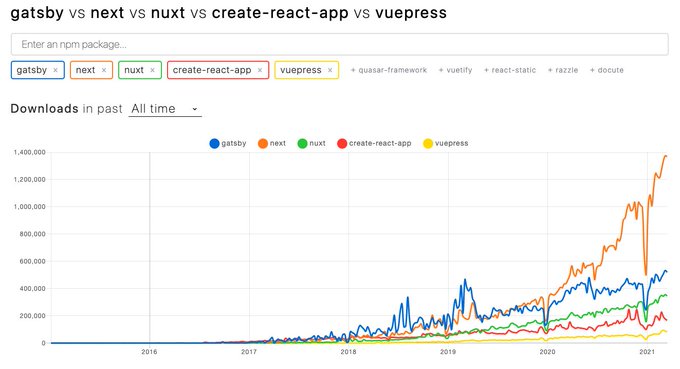
No matter how many downloads Next.js gets, or how delightful and realtime the development experience, a universal truth remains: the customer is king.
Performance for the end-user has been baked in the design of everything we make. To name some examples:
- Next.js was born out of the insight that React in its initial Single Page Application presentation was putting the rendering burden on the user's device that should have been on the server instead.
- Vercel Analytics prioritized giving you a Real Experience Score calculated by each device, rather than just listing traffic stats or TTFB latencies.
- Pre-rendering at build time or via Incremental Static Regeneration is all about taking the CPU cycles entirely out of the page serving equation, removing latency for the end user.
Our primary fitness function is your success for your customers. Not every visitor might understand fully how every page is built, but if the experience is delightful and fast, they ought to think it was powered by Vercel.
Bibliography
Sign in with GitHub to comment
Citation
Cited as:
Yotam, Kris. (Jun 2025). Basic Mathematics. krisyotam.com. https://krisyotam.com/notes/stable-syllabi/basic-mathematics
Or
@article{yotam2025basic-mathematics,
  title   = "Basic Mathematics",
  author  = "Yotam, Kris",
  journal = "krisyotam.com",
  year    = "2025",
  month   = "Jun",
  url     = "https://krisyotam.com/notes/stable-syllabi/basic-mathematics"
}